Hialeah sits on a geological puzzle. Beneath the surface, the Miami Limestone formation—locally known as Miami Oolite—is interspersed with layers of organic silt and artificial fill that have accumulated over decades of drainage and development. With a groundwater table often less than 5 feet deep, the conditions for soil liquefaction during a seismic event are far from hypothetical. The Florida peninsula is not immune to intraplate earthquakes; the 1879 event near St. Augustine registered an estimated magnitude of 4.4, and while Hialeah’s risk is moderate, the IBC classifies much of South Florida as Seismic Design Category B or C depending on site class. In our experience, the combination of shallow water and loose silty sand lenses within the oolite demands a rigorous CPT testing campaign to screen for potentially liquefiable layers before any foundation design moves forward.
Shallow groundwater and loose fill in Hialeah create a liquefaction scenario that standard presumptive bearing values fail to address.
Scope of work in Hialeah
Typical technical challenges in Hialeah
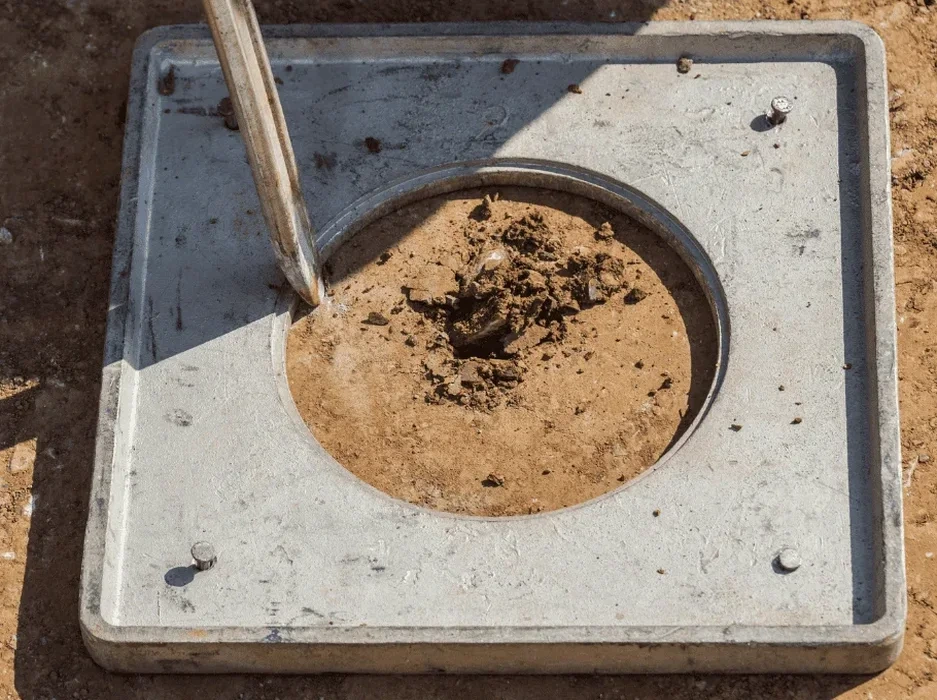
In Hialeah, a common oversight is assuming that the Miami Oolite formation is homogeneous and eliminates any risk of liquefaction. In reality, this limestone contains numerous solution pipes and sand-filled voids—legacies of ancient groundwater movement—that can undergo liquefaction during cyclic loading even if the surrounding rock stays intact. Overlooking this variability causes differential movements that lead to cracking in slab-on-grade floors and misalignment of equipment in tilt-wall warehouses. Another frequent error involves sampling only the surface fill without exploring the transition layer between fill and limestone; this interface typically hosts the most loose granular material. Omitting the assessment of post-liquefaction volumetric strain can result in a foundation design with an implicit settlement risk of several inches, which fails to meet the demands of modern logistics facilities.
Our services
Our approach to liquefaction evaluation in Hialeah combines field exploration, laboratory testing, and numerical analysis to establish a defensible factor of safety for every project. The methodology is tailored to site conditions—for example, tight urban parcels near the Hialeah Park area require different handling than open industrial sites west of the Palmetto Expressway.
CPT-Based Liquefaction Screening
We perform continuous cone penetration testing with pore pressure measurements to identify thin liquefiable layers within the Miami Oolite sequence, using the Robertson (2009) correlation for interpretation.
SPT-Based Trigger Analysis
We conduct standard penetration testing with energy-corrected N-values and apply the Youd-Idriss simplified procedure to calculate both cyclic stress ratio and cyclic resistance ratio for each stratum.
Post-Liquefaction Settlement Estimation
We use the Zhang et al. (2002) CPT-based method for volumetric strain analysis to estimate ground surface settlement under the design earthquake.
Ground Improvement Feasibility
For situations where the factor of safety is below the project-specific threshold, we evaluate remediation options such as vibrocompaction, stone columns, or rigid inclusions.
Frequently asked questions
Is liquefaction really a concern in Hialeah given Florida's low seismicity?
Yes. Although seismic activity is less than that on the West Coast, the IBC assigns a non-zero spectral acceleration to South Florida. Given Hialeah's shallow groundwater table (often less than 5 feet) and areas with loose artificial fill, the potential for liquefaction must be considered and assessed per ASCE 7 for structures in Seismic Design Category C.
What is the difference between SPT-based and CPT-based liquefaction analysis?
SPT-based methods (Youd-Idriss 2001) rely on blow counts from split-spoon samples and allow direct soil classification. CPT-based methods (Robertson 2009) provide a continuous profile with superior detection of thin liquefiable layers. In Hialeah's layered oolite and fill conditions, we often apply both techniques to cross-check results and minimize uncertainty.
How much does a liquefaction analysis cost for a Hialeah site?
A full liquefaction assessment for a typical commercial lot in Hialeah costs between US$2,380 and US$4,310, depending on factors like the number of borings or CPT soundings, investigation depth, and whether laboratory grain-size tests are needed to verify Tsuchida criteria.
What ground improvement methods work best in Miami Oolite?
The appropriate technique depends on the depth and thickness of the liquefiable layer. Vibrocompaction works well in sandy fill up to 30 feet deep. For oolite containing solution pipes with loose infill, stone columns offer both drainage and reinforcement. In low-headroom industrial retrofits, compaction grouting can be used to target specific voids.
How long does the analysis take from field work to final report?
Field exploration typically takes 1 to 2 days for a standard commercial site. Laboratory testing requires an additional 5 to 7 days for grain-size distributions and Atterberg limits. After receiving lab data, the engineering analysis and report are completed within 10 to 14 business days, but expedited schedules are possible for time-sensitive projects.