The Florida Building Code 8th Edition (2023) and ASCE 7-22 impose specific geotechnical investigation requirements for Miami-Dade County, but in Hialeah the underlying geology introduces variables that no generic report can address. The city sits on the Fort Thompson Formation, a Pleistocene limestone sequence with interbedded sand lenses and solution cavities that create abrupt vertical discontinuities in bearing capacity. A soil mechanics study here must reconcile the regional karst framework with site-specific data on cavity depth, infill material consistency, and caprock thickness, parameters that control foundation type selection from shallow footings to deep piles. When we run laboratory triaxial tests on Hialeah limestone cores, the unconfined compressive strength frequently drops by 40% across a single 5-foot interval due to vuggy porosity, a pattern that standard SPT blow counts alone cannot resolve. This is why our reports pair in-situ SPT drilling with spectral analysis of surface waves to capture the full stratigraphic profile before any foundation design moves forward.
Hialeah’s Fort Thompson limestone can lose 40% of its compressive strength across a single 5-foot interval due to vuggy porosity — a variability that standard SPT data alone will never capture.
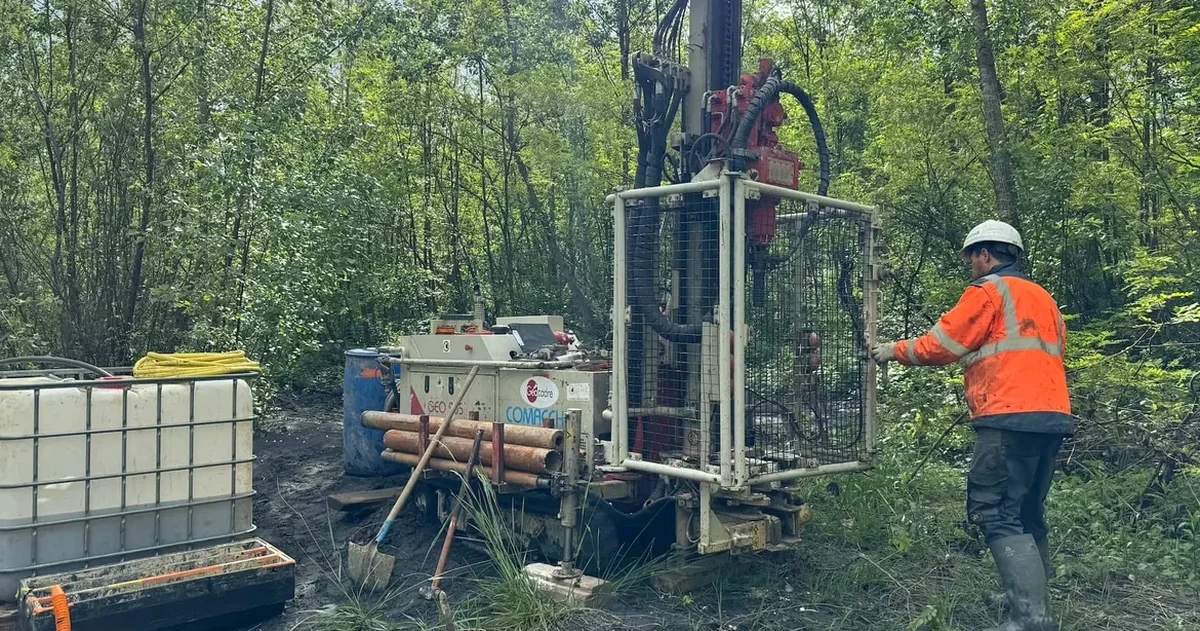
Scope of work in Hialeah
Typical technical challenges in Hialeah
Within Hialeah, the Fort Thompson Formation features numerous solution pipes and paleokarst cavities, some exceeding 15 feet in diameter, which are often packed with low-density organic silt or loose sand offering negligible end-bearing capacity. When a footing spans such a void, the caprock can experience flexural failure under much less than the assumed allowable bearing pressure, causing immediate differential settlement that shows up as structural cracks within months after occupancy. The water table lies between 4 and 7 feet deep, creating an additional risk: changing pore pressures speed up limestone dissolution, enlarging existing voids and forming new ones over the building's lifespan. Without ground-penetrating radar or electrical resistivity profiling, a soil mechanics study may miss critical karst features beneath foundations, leading to emergency grouting and, in several recorded Miami-Dade cases, partial demolition of newly poured slabs.
Our services
A soil mechanics study in Hialeah must cover the interaction among karst geology, high groundwater, and hurricane wind demands. Our laboratory and field programs are designed to produce defensible geotechnical parameters for foundation design, earthwork specifications, and underground utility installation in line with the city's permitting requirements.
Foundation Design Parameter Report
By combining SPT and CPT field data with triaxial and consolidation laboratory testing, we determine bearing capacity, settlement, and skin friction values for shallow footings, mat foundations, or deep piles in accordance with IBC Chapter 18 and ASCE 7-22 load combinations.
Karst Hazard Assessment
We use electrical resistivity tomography and ground-penetrating radar surveys to map solution cavities, caprock thickness, and infill material properties, producing a risk matrix that guides foundation location and depth decisions.
Hydrostatic and Uplift Analysis
Buoyant forces on below-grade structures are calculated using seasonal high water table data, with recommendations for underdrain systems, waterproofing, and structural dead-weight compensation to meet the Florida Building Code's flotation safety factor of 1.2.
Frequently asked questions
What does a soil mechanics study in Hialeah typically cost for a single-family home project?
For a typical residential lot in Hialeah, the fee ranges from US$3,500 to US$5,020, depending on the number of borings, required laboratory tests, and whether karst geophysical surveys are included. A standard scope involves two SPT borings to 25 feet, laboratory classification and strength tests, and a signed geotechnical report suitable for Miami-Dade County permitting.
How deep must borings go for a soil mechanics study in Hialeah given the limestone caprock?
According to the Florida Building Code, borings must extend below the expected foundation influence zone; in Hialeah's karst terrain, this usually means penetrating the caprock and ending at least 10 feet into competent limestone or until refusal on dense rock. For a two-story structure on shallow footings, 25 to 35 feet is typical, but deeper borings are required when solution cavities are found.
Does a soil mechanics study in Hialeah have to address hurricane wind loads explicitly?
Yes. ASCE 7-22 design wind speeds for Hialeah reach 175 mph ultimate for Risk Category II structures, imposing substantial overturning and uplift demands on foundations. The geotechnical report must provide soil stiffness parameters for lateral load analysis and confirm that the foundation system can resist wind-induced moments without exceeding allowable bearing pressures or causing unacceptable rotation.
How long does it take to receive the final geotechnical report after field work in Hialeah?
Field drilling and sampling typically take one to two days on site. Laboratory testing adds 10 to 14 business days, depending on whether consolidation or triaxial tests are needed. The final report with foundation recommendations is usually delivered within three weeks after field completion, though expedited turnaround is available for time-sensitive projects.