Tunneling through Hialeah’s subsurface demands more than standard geotechnical procedures—it requires a forensic understanding of South Florida’s unique geology. The city sits atop the Biscayne Aquifer, where layers of Miami Limestone, sand, and organic silts create a mixed-face condition that complicates every linear foot of excavation. ASCE 7-22 and the Florida Building Code mandate rigorous site characterization before any underground work begins. Our team applies ASTM D1586 standard penetration tests and ASTM D2487 soil classification to map the transition zones between cemented rock and soft ground. This is not theoretical work. Hialeah’s water table often sits less than six feet below grade, meaning tunnel alignment decisions must account for hydrostatic pressure from the very first core sample. Before finalizing a tunnel boring machine selection, we often complement borehole data with a CPT test to capture continuous stratigraphic profiles in loose, saturated sands where SPT recovery can be misleading.
Hialeah’s water table at six feet below grade transforms routine tunnel design into a continuous exercise in dewatering and face stability control.
Scope of work in Hialeah
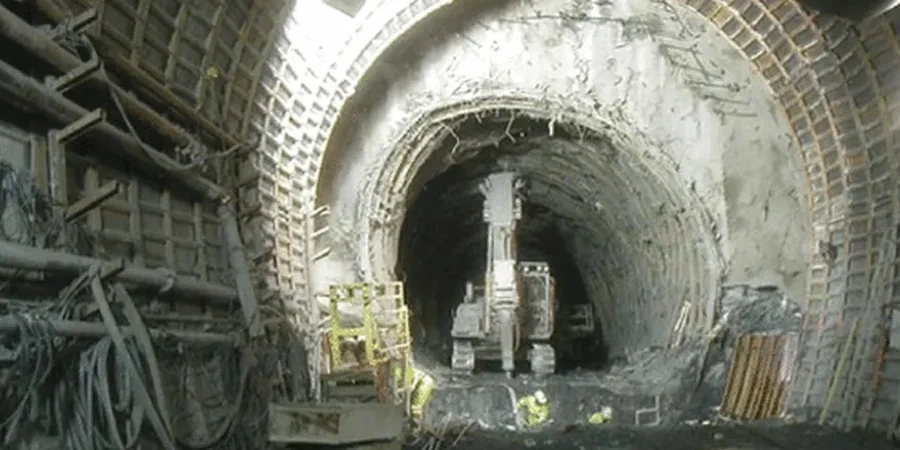
Typical technical challenges in Hialeah
With an elevation of roughly 6 feet above mean sea level, Hialeah is among the lowest cities in Miami-Dade County. This low elevation, coupled with a shallow aquifer, makes tunnel projects highly susceptible to groundwater inflow during construction. The heavy rainfall events in South Florida during 2023 demonstrated how rapidly the water table can rise, causing the upper soil layers to become saturated and eliminating the apparent cohesion that designers often rely on for unsupported stand-up time. For tunnels excavated in soft ground, typical failure mechanisms include face collapse, blowout into overlying cohesive strata, and long-term settlement that can damage surface structures along Hialeah Drive and West 49th Street. Through coupled flow-deformation modeling, our analysis quantifies these risks, providing contractors with a clear understanding of required face support pressures and grouting volumes before mobilization starts.
Our services
Our geotechnical services for soft ground tunnels in Hialeah encompass the entire lifecycle, from feasibility studies through construction support. Each program is customized based on the specific alignment and the mixed-face conditions characteristic of tunneling in Miami-Dade County.
Tunnel Alignment Geotechnical Baseline Report
Using SPT borings, CPT soundings, and laboratory strength testing, we establish geotechnical baselines along the proposed alignment. The resulting report defines contractually actionable ground behavior parameters, such as face stability ratios, settlement trough widths, and anticipated dewatering volumes for each tunnel reach.
Construction-Phase Instrumentation and Monitoring
To monitor ground response in real time during excavation, we install vibrating wire piezometers, inclinometers, and surface settlement points. Data from these instruments feeds back into our predictive models, enabling the contractor to adjust face pressure and grouting quantities before minor movements escalate into claims.
Frequently asked questions
What makes Hialeah’s soil so challenging for tunnel construction?
Hialeah is underlain by a complex interlayering of Miami Limestone, loose sands, and pockets of organic silt and peat. The water table is extremely high, typically just three to seven feet below the surface. This results in mixed-face conditions where a tunnel boring machine encounters soft soil and hard limestone within the same heading, complicating face pressure control and raising the risk of over-excavation or sinkhole development above the tunnel crown.
What is the typical cost range for a geotechnical analysis of a soft soil tunnel project in Hialeah?
For a thorough geotechnical analysis covering a typical tunnel alignment in Hialeah, budgets range from US$4,680 to US$16,960. The cost depends on factors such as the number of borings, the laboratory testing program, and the need for advanced numerical modeling. Shorter alignments with limited access tend to be at the lower end, while longer tunnels requiring continuous CPT profiles and 3D finite element analysis approach the upper end.
How do you deal with groundwater during tunnel design in Hialeah?
Groundwater is treated as a primary design load in our approach, not an afterthought. Our methodology includes in-situ permeability testing at multiple depths, pore pressure monitoring, and steady-state seepage analyses. For tunnels located below the water table, we design face support pressures that balance hydrostatic conditions and specify grouting programs—typically permeation grouting in sands and jet grouting in mixed soils—to cut off flow paths before the tunnel face reaches a given station.