Anchor system design in South Florida demands a precise understanding of the interface between structural loads and the region's unique geology. The Hialeah area, underlain by the Miami Limestone formation and characterized by a shallow water table often less than 1.5 meters below grade, requires strict adherence to the IBC Chapter 18 and PTI (Post-Tensioning Institute) recommendations for grouted ground anchors. Our team approaches each project by first quantifying the bond stress capacity within the oolitic limestone, a parameter that can vary significantly between the soft, porous caprock and the denser, more competent strata beneath. For projects requiring deep foundation alternatives, we frequently integrate pile load testing to validate capacity assumptions when anchors are combined with structural piles. The load-transfer mechanism of an active anchor, which locks off force against the structure immediately, differs fundamentally from a passive system that only engages as the retained mass moves, making the correct specification critical for excavations and retaining walls in the city's variable fill and solution-weathered rock.
A properly executed anchor test in Miami Limestone should demonstrate minimal residual creep, typically less than 0.04 inches over a 10-minute hold period, confirming the bond stress assumptions.
Scope of work in Hialeah
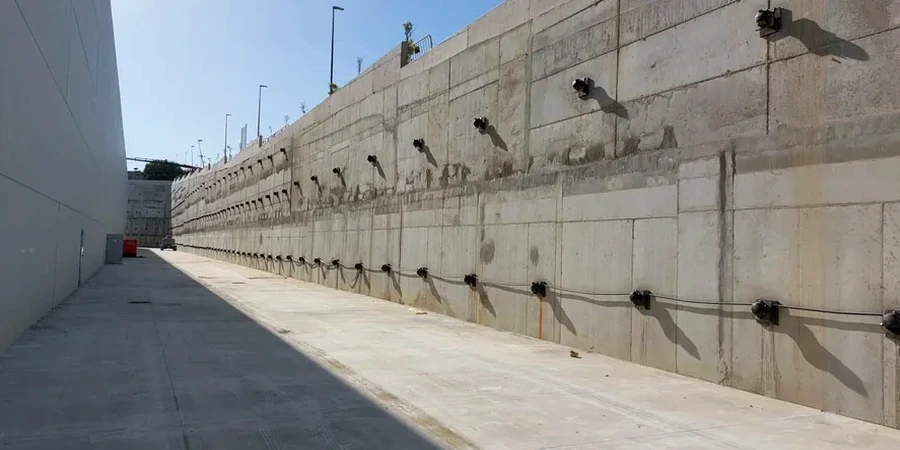
Typical technical challenges in Hialeah
The aggressive environment for ground anchors in Hialeah cannot be underestimated, driven by the subtropical climate with intense summer rainfall exceeding 60 inches annually and the constant threat of hurricane-driven storm surge. The combination of a near-surface brackish groundwater table and the high porosity of the Miami Limestone increases the risk of chloride-induced stress corrosion cracking in high-strength steel tendons—a failure mode that can occur without visible warning if the encapsulation system is damaged during installation. Therefore, we mandate double-corrosion protection (Class I) for all permanent anchors in the city, strictly following PTI DC35.1-14. Wind events impose cyclic loading on tied-back retaining walls, requiring a dynamic assessment of the lock-off load since tendons can lose up to 15% of their initial force within the first 48 hours due to seating losses and rock creep if not properly re-shimmed. In Miami-Dade County excavations, neglecting the hydrostatic pressure buildup behind a wall during a heavy rain event is perhaps the most common cause of anchor distress.
Our services
Our laboratory performs anchor design validation and quality control testing customized for the geological conditions of northwestern Miami-Dade County, focusing on the interaction between the grout column and the limestone bedrock.
Anchor Proof and Performance Testing
We carry out on-site load tests with hydraulic jacks and calibrated load cells to verify the ultimate bond stress in the Miami Limestone formation, following the incremental loading and unloading cycles outlined in ASTM D3689.
Tendon Corrosion Risk Assessment
We assess groundwater samples for chlorides, sulfates, and pH levels to determine the appropriate PTI encapsulation class, ensuring the anchor system's longevity against Hialeah's aggressive soil and water chemistry.
Lift-Off and Creep Monitoring
We perform lift-off tests on existing anchors to gauge the residual lock-off load and run extended creep tests to identify potential bond failure in passive anchors subjected to sustained earth pressures.
Frequently asked questions
What is the difference between an active and a passive anchor?
An active anchor is tensioned against the structure right after installation, applying a pre-compressive force to the ground or retained element, thereby preventing movement. In contrast, a passive anchor is not tensioned until the structure starts to displace, meaning it only engages to resist loads after some deformation has occurred.
How much does an anchor design and testing program cost in Hialeah?
For a typical project involving design verification and on-site proof testing in Hialeah, the budget generally falls between US$1,190 and US$3,470, depending on the number of sacrificial test anchors and the complexity of access for the hydraulic rig.
Why is double corrosion protection required for permanent anchors in Miami-Dade?
The high groundwater table in Hialeah, along with the brackish water intrusion common in South Florida, creates a corrosive environment that can quickly degrade unprotected steel. PTI Class I protection employs corrugated sheathing and encapsulation to isolate the tendon from aggressive ions.
How do you handle grout loss in the porous Miami Limestone?
We specify a low-mobility, cohesive grout mix with a water-cement ratio typically between 0.40 and 0.45. If significant voids are encountered during drilling, we pre-grout the borehole using a tremie method to seal the fissures before installing the permanent tendon. More info.