A six-story mixed-use building going up on West 49th Street hit an unexpected layer of silty sand at 8 feet. The fill didn't match the specs, and the concrete pour was on hold. Our lab ran a full ASTM D6913 sieve analysis with D7928 hydrometer on the material. Forty-eight hours later the engineer had a complete gradation curve, the Atterberg limits, and a reclassified soil that saved the footing design from a costly over-excavation. Hialeah sits on porous limestone with pockets of transported fine sands and organic silts, so assuming uniform material is a gamble. We test it. You build on certainty. When the grain distribution matters for drainage, compaction, or frost protection, we combine our analysis with field verification like the sand cone density test to confirm that the placed fill actually meets the lab target.
Uniformity coefficient and fines content determine drainage behavior. If you don't wash the minus #200, you're guessing.
Scope of work in Hialeah
Typical technical challenges in Hialeah
Over time, the Miami Limestone underlying Hialeah undergoes dissolution, forming zones of raveling and non-uniform voids that contain organic matter and silty sand. When engineered fill is placed over such pockets without verifying grain size distribution, there is a risk of uneven settlement and inadequate drainage, which can cause pavement cracking within two seasons. The hydrometer fraction is particularly critical here. Materials passing the No. 200 sieve (silts and clays) govern permeability and susceptibility to frost, even in South Florida's climate, where saturation is the primary concern. A fill material that satisfies the coarse sieve specification may still fail to meet the fines requirement. We detect such issues before the compaction crew departs the site. The IBC references ASTM D2487 for classification, and Hialeah's building department requires its use on any project that necessitates a geotechnical report.
Our services
Our service list is designed to be practical. You require data that is both rapid and defensible under review. All testing is performed in-house using calibrated equipment.
Full Sieve + Hydrometer Package
A single sample undergoes combined analysis per ASTM D6913 and D7928. This includes wash sieve testing, generation of a complete gradation curve, calculation of Cu/Cc coefficients, classification according to USCS, and provision of a signed report. This test is standard for fill verification and drainage design.
Rapid Wash Sieve (Minus #200)
Contractors requiring same-day fines content can opt for a focused test. This involves only a wash sieve conducted per ASTM D1140. It is employed during fill placement to verify material cleanliness prior to compaction.
Frequently asked questions
How much does a grain size analysis cost in Hialeah?
The cost of a standard combined sieve and hydrometer test is usually between US$90 and US$200, varying based on whether full hydrometer sedimentation or only a wash sieve for fines content is required. Expedited turnaround incurs a small additional charge. After we know the sample count and testing depth, we will provide a fixed quote.
What is the difference between a sieve analysis and a hydrometer test?
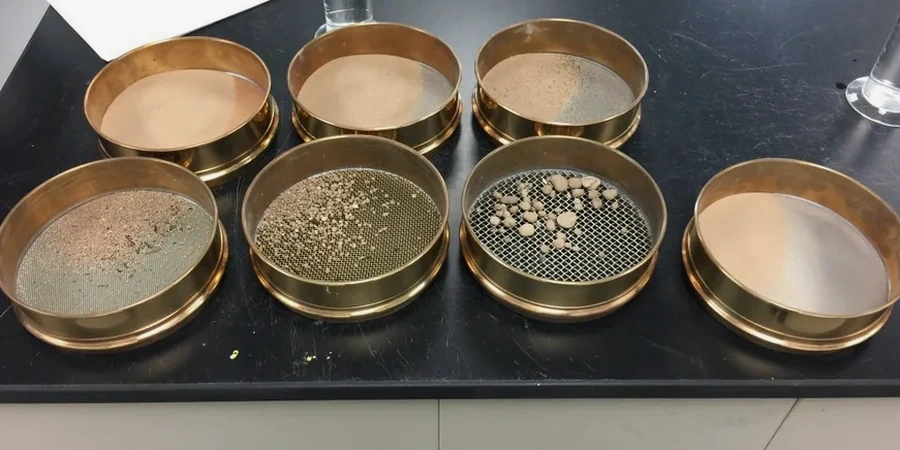
Particles larger than 0.075 mm (No. 200 sieve) are analyzed via sieve analysis, which employs a stack of sieves and a mechanical shaker. The silt and clay fraction, smaller than 0.075 mm, is handled by the hydrometer test, which measures sedimentation rates in a water column according to Stokes' law. The combination of these two methods yields the full particle-size distribution curve.
How soon can I get results for a fill material check?
A full ASTM D6913/D7928 report typically has a turnaround of two to three business days. For cases where only the wash sieve percentage passing #200 is required, same-day results are often possible if the sample is received before noon. Please contact us before dispatching the sample so we can arrange the schedule.
What classification system do you use for the soil?
All soils are classified according to ASTM D2487, which is the Unified Soil Classification System (USCS). The IBC references this system, and it is mandated by Hialeah building officials. Your report will contain the group symbol (such as GW, SP, CL) and the group name.