In Hialeah we often encounter a subsurface scenario that catches contractors off guard: a few feet of compacted fill sitting over loose to medium-dense sand, which in turn caps the porous Miami Oolite limestone at depths of 15 to 25 feet. When a warehouse slab or a three-story apartment building goes up on that profile, differential settlement shows up within the first rainy season. Vibrocompaction design addresses that risk directly by specifying probe spacing, vibration frequency, and duration to densify the sand layer before footings go in. Our laboratory runs the pre-design SPT drilling to measure N-values every 2.5 feet, then correlates those numbers with grain-size curves to predict how the sand will respond to vibratory energy. The goal is a uniform relative density above 70 percent across the entire footprint, which cuts post-construction settlement to less than half an inch in most Hialeah projects we have monitored.
A well-designed vibrocompaction program in Hialeah’s sand-over-limestone profile can double the SPT blow count between 5 and 15 feet depth with just two passes per probe.
Scope of work in Hialeah
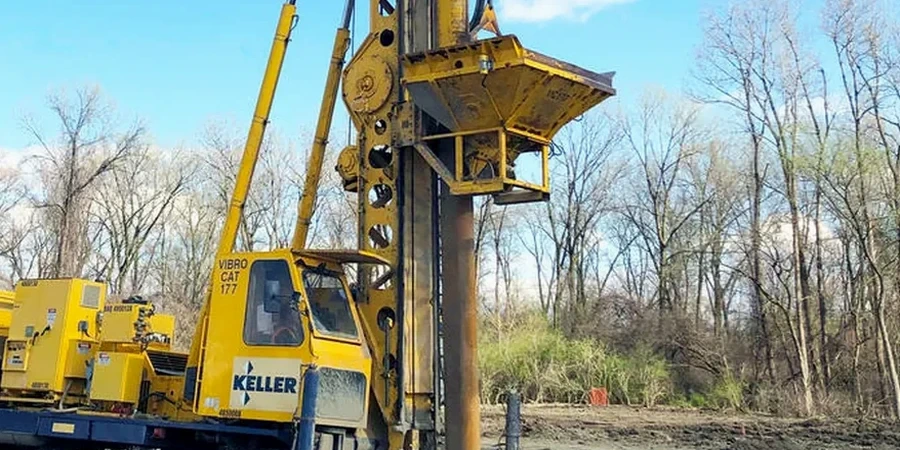
Typical technical challenges in Hialeah
Hialeah’s elevation is approximately 7 feet above mean sea level, and its water table varies seasonally between 3 and 6 feet below the surface, influenced by canal levels. This high groundwater condition, together with a dense urban population of 223,000, demands that ground improvement be conducted with precision, low noise, and efficiency. The primary geotechnical hazard involves loose sand lenses located within the top 10 feet, which are susceptible to liquefaction under ASCE 7-22 seismic loads, despite South Florida being a region of low seismicity. If these lenses remain untreated, wind-induced vibrations from a Category 3 hurricane transmitted through buildings could cause several inches of settlement in a single night. Our vibrocompaction approach employs CPT tip resistance correlations and SPT blow counts to delineate these lenses with sufficient detail, allowing probe spacing to be reduced from 6 feet to 4 feet in areas with clean, uniform sand.
Our services
The vibrocompaction design package we offer encompasses the entire process, starting from subsurface exploration through to post-treatment confirmation, and is specifically tailored to Hialeah’s stratigraphy, which is dominated by limestone.
Pre-Design Site Characterization
Standard penetration test (SPT) borings are performed on a 50-foot grid throughout the site, with detailed logging focusing on the continuity of sand layers and the depth at which limestone is encountered.
Vibrocompaction Trial Program
A test section involving three points is established, using different probe spacings and pass numbers to adjust the vibration energy according to the grain-size distribution of the sand prior to commencing full-scale production.
Production Monitoring and Logging
At each probe location, we record ammeter draw, penetration rate, and vibration duration in real time. This data is compiled into a digital as-built report submitted to the engineer of record.
Post-Treatment Verification Testing
Post-treatment verification includes SPT borings at 10% of the compaction points, supplemented by dynamic probing super heavy (DPSH) or cone penetration test (CPT) soundings in areas requiring rapid coverage between borings to ensure uniform densification.
Frequently asked questions
What soil conditions in Hialeah make vibrocompaction the right choice over stone columns?
If the sand layer located between 5 and 20 feet below grade contains fines (by weight) below 12% and the underlying limestone is sufficiently shallow to act as a natural plug, then vibrocompaction alone is both quicker and more cost-effective. We conduct a pre-design sieve analysis to verify the grain-size distribution; should the fines content surpass 12%, stone columns are advised because silt and clay attenuate vibratory energy, hindering effective densification.
How do you handle vibration monitoring near existing structures in Hialeah’s dense neighborhoods?
Three-axis seismographs are installed on nearby building foundations and along property boundaries to monitor peak particle velocity in real time. The vibrator frequency is maintained between 1,200 and 1,800 rpm to ensure it remains below the 0.5 in/sec limit typically acceptable for residential buildings located within 30 feet. When readings near 0.3 in/sec, we lower the amplitude and utilize a pre-drilled pilot hole to isolate the probe from the limestone layer.
What does a typical vibrocompaction design package cost for a Hialeah commercial lot?
For a typical 10,000-square-foot commercial site in Hialeah, the full design package—which encompasses pre-design SPT borings, grain-size analysis in the lab, vibrocompaction layout and specifications, as well as post-treatment verification—typically costs between US$1,640 and US$5,500. The final price varies based on the number of borings needed, the necessity of a trial program, and the depth to the limestone refusal surface across the site.