Beneath Hialeah's neighborhoods, actual subsurface conditions vary drastically from the common ASCE 7 Site Class D default often seen in geotechnical reports west of the Palmetto Expressway. The porous Miami Limestone, intermittent dense sand layers, and a water table only 4 to 6 ft below grade cause shear-wave velocities to range from 500 to over 1,200 ft/s even within a single block. Instead of relying on that blanket classification, a microzonation study provides measured Vs30 profiles, site period estimates, and amplification factors specific to your exact project location. Such analyses are performed for new hospital wings, mid-rise residential buildings, and critical infrastructure where the IBC mandates site-specific response spectra. The outcome typically includes reduced foundation demands, fewer deep piles needed, or a design that passes building department review without delays.
Two sites separated by half a mile in Hialeah can show a 40 percent difference in spectral acceleration at 1-second period. The geology demands site-specific measurement.
Scope of work in Hialeah
Demonstration video
Typical technical challenges in Hialeah
During Hurricane Irma in 2017, several commercial structures in eastern Hialeah suffered settlement damage not caused by wind or flood, highlighting how long-period ground motion from far-off seismic events can resonate in the basin's soft soils. That risk stems from Hialeah's location on the Everglades basin edge, where the water table remains near the surface from June through October. The saturated fine sand layers deposited by historical sheet flow create conditions for seismic-induced settlement even at moderate PGA levels. The primary concern is not structural collapse but differential settlement from pore-pressure buildup in loose saturated lenses that a standard site class report would overlook. A microzonation study pinpoints those lenses and maps their extent, empowering the foundation engineer to decide on densification, over-excavation, or relying on a mat foundation without costly ground improvement.
Our services
A microzonation study in Hialeah consistently begins with a site reconnaissance and examination of prior geotechnical records, though the scope of field work and analysis is tailored to the building type and location. The following describes the typical components of a comprehensive site-specific ground motion evaluation.
MASW and ReMi Surface Wave Surveys
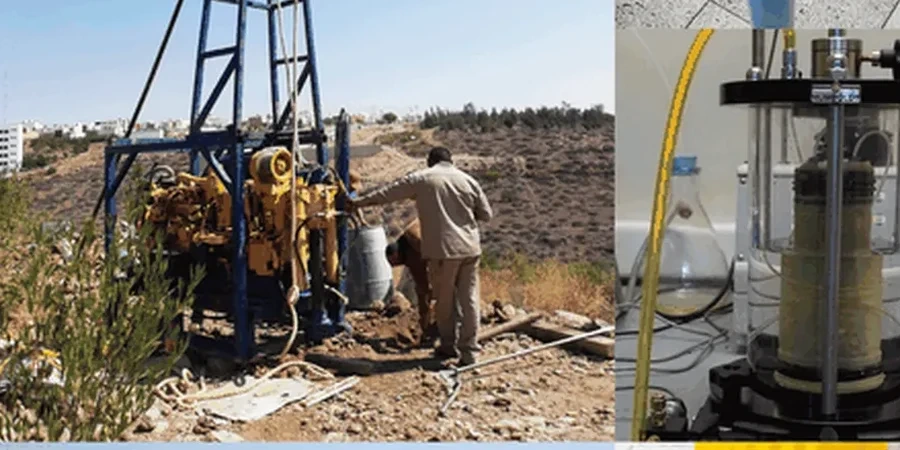
We deploy multi-channel arrays over the property to obtain 1D and 2D shear-wave velocity profiles. In-house processing of the dispersion curves, followed by inversion against borehole control data, yields a calibrated Vs30 map that spans the entire building footprint.
Downhole Seismic and Suspension Logging
Shear-wave travel times are measured in boreholes using a triaxial geophone at 2.5-foot increments. These high-resolution control points anchor the surface-wave data and meet the Florida Building Code's requirement for site-specific investigation of Site Class F candidates.
Site Response and Amplification Analysis
Ground response is analyzed with one-dimensional equivalent-linear or nonlinear methods using DEEPSOIL or comparable software. Inputting the measured Vs profile and modulus reduction curves generates the surface response spectrum, amplification factors Fa and Fv, and the ground-level time history for structural modeling.
Liquefaction Potential Index Mapping
We spatially evaluate cyclic stress ratio against cyclic resistance ratio throughout the site, based on CPT tip resistance or SPT blow counts. The outcome includes a color-contoured map of LPI zones, indicating precisely where mitigation is required and where it can be omitted.
Frequently asked questions
How much does a seismic microzonation study cost for a typical Hialeah commercial lot?
For a typical commercial lot ranging from 0.5 to 2 acres, the full microzonation package—comprising MASW lines, two downhole seismic boreholes, site response analysis, and a final mapped report—costs between US$3,860 and US$17,040. The price varies with the number of measurement points, required investigation depth, and whether CPT soundings for liquefaction assessment are necessary. After reviewing the site plan and any available geotechnical data, we issue a fixed-fee proposal.
Does Hialeah actually need seismic microzonation? Florida isn't known for earthquakes.
Seismic load consideration remains mandatory under the Florida Building Code. The default Site Class D assumption may be too conservative for western Hialeah's dense limestone ridges or unconservative for the eastern basin's loose saturated sands. A microzonation study substitutes measured values for defaults, frequently lowering design base shear and removing superfluous foundation expenses. Additionally, it mitigates the genuine hazard of long-period ground motion impacting taller buildings, even from remote seismic sources such as the Caribbean or the Puerto Rico Trench.
How long does the field work and reporting take for a microzonation project?
Field work for a typical commercial site in Hialeah takes two to three days, covering the MASW array deployment, downhole seismic logging, and any supplementary CPT soundings. Data processing and inversion modeling require another five to seven business days. The final report, including the site response spectra, amplification maps, and liquefaction potential index contours, is usually delivered within three weeks of completing the field campaign. More info.